Mike Westbrook 1936 - 2026
Tribute
Tribute


A Tribute to Mike Westbrook - The Blake Society
If William Blake were a contemporary musician, he would certainly be so in the likeness of Mike Westbrook, who, as many might know, started off as a painter. Like Blake, Mike abhorred paltry rhymes and paltry harmonies, as he declares in his epic Milton. He also shared Blake’s deep understanding that poetry, painting, and music are elevated into their "own proper sphere of invention and visionary conception", existing and exulting "in immortal thoughts". Blake refused the constraints of convention and pursued a form that remained faithful to his own imaginative and spiritual imperatives. That is another resemblance to Mike, who never bent to the demands of the market, and held to a music that answered only to its own inner necessity.
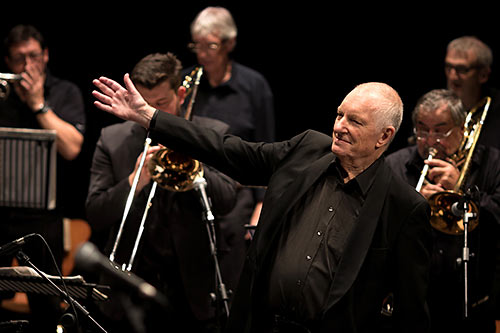
Mike had the musical and poetic sensibility to recreate the melodies that Blake did not leave encoded in bars and crotchets. And he could do so with both short lines, which he called Fairies, and long lines, called Giants. For Blake, they were all equally musical. And Mike understood this like no other composer. He was extremely attentive to the inward measure of the poems, attending to the minutest particulars of every line, extracting their meaning and intentionality, and making them sound exactly as they should.
Blake was omnivorous, and he appreciated both what we call high and popular culture. The arias sung in the 18th-century pleasure gardens, as well as the folk ballads were incorporated into his poetry as if they had always belonged together. Mike was no less so, and he moved easily between the concert hall and the street, merging jazz, classical music, theatre, folk and rock without hierarchies.
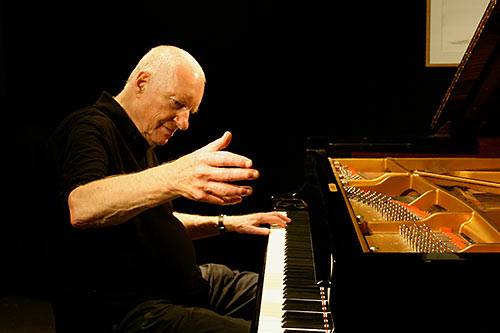
Apropos of hierarchies, both Mike Westbrook and William Blake fiercely opposed all forms of social division and the notion that some lives matter more than others. Mike found in Blake a like-minded soul who could not remain indifferent to exploitation, bigotry, poverty, and violence. Although Mike esteemed Blake for his striking clarity in perceiving both good and evil in the world, he admired him even more for consistently taking the side of those oppressed by that very evil.
The relationship of creative affiliation between Mike and Blake recalls that of Blake and Milton, where the work of the successor becomes a continuation, or even a refinement, of the predecessor. Through Mike’s settings, Blake sounds as he should sound today, and moves us as he should move us today. It could not be more faithful to Blake in form and spirit, at the same time it couldn't be more distinctly Westbrookian.
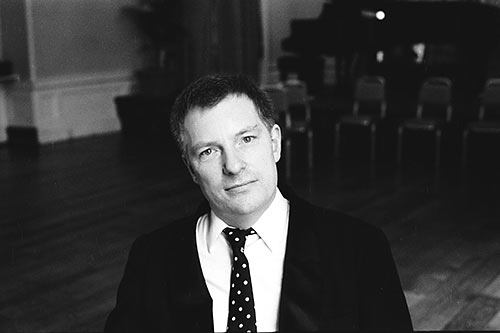
His enduring admiration for, and commitment to, Blake’s legacy will always be remembered, and The Blake Society is more than honoured to have him and his wife Kate as patrons. May he and Blake meet in eternity, and improvise some new songs of innocence and experience with a heavenly band.
Mike Westbrook obituary
Richard Williams - The Guardian
Richard Williams - The Guardian
Acclaimed musician, composer and bandleader who was one of the most significant figures in the history of British jazz
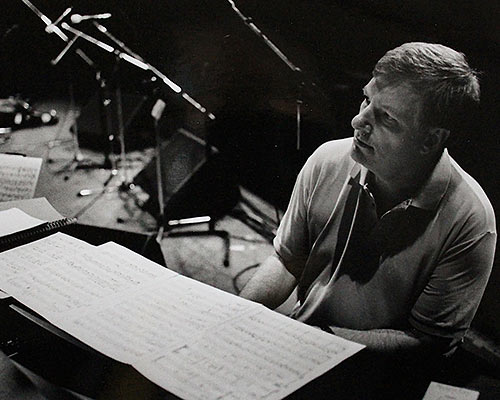
‘Being a jazz musician is for life,” Mike Westbrook once said. ‘There’s no retirement, no pension. And there’s always the lure of the next gig, the next project, which is going to be your best yet.’
Photograph: Nick White
Photograph: Nick White
As Ronnie Scott’s Old Place – the original basement club on Gerrard Street in London’s Chinatown – prepared to close its doors for the final time on 25 May 1968, the last musicians to take the stand were the 10 young members of Mike Westbrook’s Concert Band.
Recruited from a variety of backgrounds, they formed the vehicle with which their leader had begun to demonstrate his gift for slotting together elements of jazz from various periods and styles, filtering them all through his own sensibility to produce something thoroughly stirring, definitely contemporary and highly original. A capacity audience had queued all the way from the club’s entrance to Shaftesbury Avenue, and stayed on at the end to applaud the work of a musician on his way to becoming one of the most significant and productive figures in the history of British jazz.
That was just one of the countless memorable moments in the long career of Mike Westbrook, who has died aged 90. While studying in Plymouth in the 1950s, he had begun by assembling a band that called itself a workshop, a designation used by other jazz musicians of the era, particularly those keen to find new ways of negotiating the relationship between composition and improvisation.
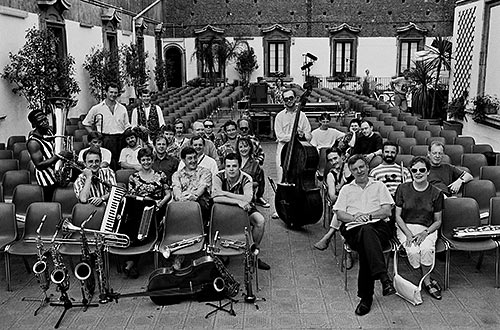
The Mike Westbrook Orchestra in Catania, Sicily.
Photograph: Guy Le Querrec
Photograph: Guy Le Querrec
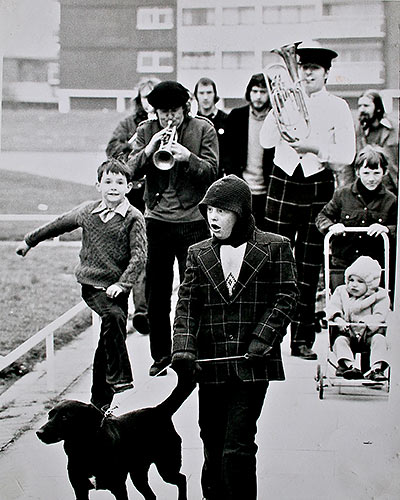
And that, in a sense, became the permanent condition of Westbrook’s music, whether he was performing his settings of William Blake’s poetry, adapting the compositions of Duke Ellington – his first and forever hero – or the songs from the Beatles’ Abbey Road. He collaborated on theatre pieces with John Fox and the Welfare State, led his brass band through the streets of French villages, worked with his second wife, the singer and librettist Kate Westbrook, and performed his arrangements of Rossini’s arias and overtures at the Albert Hall in 1992, in the first jazz concert to be incorporated into the main programme of the BBC Proms.
Although he was English, and it was on British stages that he first came to prominence, there was a feeling that Westbrook was more profoundly appreciated elsewhere.
In 1984 two French jazz festivals, in Amiens and Angoulême, jointly commissioned the suite On Duke’s Birthday, his celebration of Ellingtonia. In the summer of 1992, the local jazz association of Catania in Sicily organised a Mike Westbrook music festival, flying in a 25-piece ensemble to perform his music over three days on the terrace of a baroque palazzo. The Rossini arrangements would receive a kind of homecoming in 2022, when performed by his last big band, the Uncommon Orchestra, at the 18th-century Teatro Rossini in Lugo, in the province of Ravenna.
Mike Westbrook and the Uncommon Orchestra in Catania in 2018
In his final years he occasionally gave intimate solo piano recitals in which, for an unbroken hour, sometimes two, he would range through gospel tunes, folk songs, pop ballads and jazz standards, revealing his inclusive and humanistic view of music.
Gentle reshapings of Mood Indigo, My Way, As Time Goes By, Skylark, Monk’s Mood, She Loves You, Goodbye Pork Pie Hat and You Make Me Feel Brand New would form a continuous tapestry, exposing new shadings and perspectives at every turn, played without irony and from the heart.
Born in the town of High Wycombe, Buckinghamshire, Mike was the son of Philip Westbrook, who worked in banking and was an amateur percussionist, and Vera (nee Butler), a piano teacher. Imbued by them with a love of music and theatre, he was brought up in Torquay and Plymouth and educated at Kelly college, Tavistock.
Camila Oliveira Querino has also written this obituary on the Blake Society Website
In his teens he became fascinated by the recordings of Ellington, Louis Armstrong, Jelly Roll Morton and Fats Waller, which provided him with a grounding in jazz tradition that would underpin all his music, even at its most experimental. The trumpet was his first instrument (and later he would occasionally play the tenor horn and tuba in his bands), but he switched to the piano early on, teaching himself to play and to read music.
His training in accountancy was interrupted by national service, after which he began studying painting at Plymouth Art College. It was at the town’s arts centre that his first band was assembled: an octet including a young soprano and baritone saxophonist named John Surman, a prodigy who would become Westbrook’s primary featured soloist.
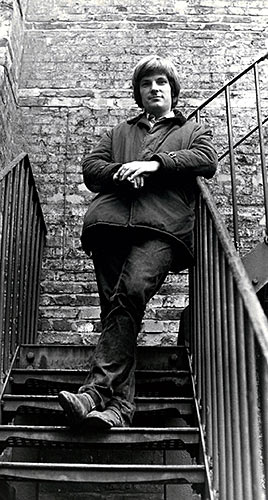
In 1963, having worked for a while as a scenic artist at Westward TV, he moved to London, continuing his studies at Hornsey School of Art. He and Surman were soon joined by the alto saxophonist Mike Osborne, the trombonist Malcolm Griffiths, the bassist Harry Miller and the drummer Alan Jackson, in a sextet that began to attract attention.
When Ronnie Scott, having moved his club to a new location, found himself with 18 months left of a lease on his former premises, he invited Westbrook and his band to take up residence at the Old Place, giving them the chance to build an audience and establish a reputation. On other nights Westbrook would appear with different musicians at the Little Theatre Club in Covent Garden, where he absorbed important new directions in free improvisation.
Mike Westbrook in the 1960s. Photograph: Jane Bown/The Observer
In these surroundings he could explore and shape the material for the extended pieces that would become the albums Celebration (1967), Release (1968) and Marching Song (1969). All three suites featured expanded versions of the core band, demonstrating Westbrook’s burgeoning artistic ambitions, and were recorded by the producer Peter Eden for Deram, Decca’s “progressive” subsidiary label, at a time when major record companies were still occasionally taking a chance on young jazz musicians.
Yet it would quickly become apparent that Westbrook was not content to inhabit such a limited world or conform to the expectations of its gatekeepers. After an Arts Council grant of £500 enabled him to give up his teaching job and turn professional, and Surman had left to base himself in Belgium, the premiere of a further extended piece, Metropolis, at the Mermaid theatre was followed by a collaboration with John Fox and the Welfare State troupe on an ambitious multimedia work called Earthrise, which received its first performance at the same venue in 1969. The introduction of Blake into Westbrook’s repertoire came about when Adrian Mitchell invited him to contribute the music to Tyger, a celebration of the visionary poet’s work, first performed at the New theatre in 1971.
By now the rhythms and timbres of rock were finding their way into Westbrook’s music, signalled by the presence of the guitarists Chris Spedding, Gary Boyle and Brian Godding, along with voices, at first that of Norma Winstone, on an album titled Love Songs (1970), a suite inspired by the poems of Westbrook’s first wife, Caroline Menis. In 1972 Westbrook’s working band was renamed Solid Gold Cadillac, and recorded two albums for RCA featuring the singer and trumpeter Phil Minton.
Then the group changed shape to become the Brass Band, which toured throughout Europe and occasionally merged with the rock group Henry Cow and the folk singer Frankie Armstrong to form the Orkestra.
In 1974 Westbrook was commissioned by Radio Sweden to write a major piece featuring Surman. He began its outlines while spending time in Leeds, where the painter, singer, composer and librettist Kate Barnard, his future second wife, was teaching at the art college. The title of the composition, Citadel/Room 315, referred to the room in a tower block where Westbrook worked on the piece, which was first performed in Stockholm and then recorded with his British orchestra for RCA.
Kate, whom he married in 1976, became a constant presence, an equal partner in many of their projects, singing their original songs and settings of lyrics from many sources, including the works of Goethe, Lorca, Rimbaud, Masefield and Siegfried Sassoon. She brought a powerful hint of Weimar-era cabaret to such works as Mama Chicago, The Serpent Hit and Art Wolf, dedicated to the 18th-century German landscape painter Caspar Wolf.
As a duo, in 1997 they recorded Love Or Infatuation, an album of songs by Friedrich Hollaender, the film composer who wrote Falling in Love Again for Marlene Dietrich. With the saxophonist Chris Biscoe, the Westbrooks formed a trio that would tour and record for 40 years.
In 1980 Westbrook composed the music for Caught on a Train, a BBC TV drama written by Stephen Poliakoff, starring Peggy Ashcroft and Michael Kitchen. A saxophone concerto for John Harle and the Bournemouth Sinfonietta, titled Bean Rows and Blues Shots, received its premiere in 1992. A concert version of Coming Through Slaughter, his opera based on Michael Ondaatje’s novel about the New Orleans cornetist Buddy Bolden, was performed at the Queen Elizabeth Hall in 1994.
The major orchestral works, some of them incorporating classical musicians alongside Westbrook’s own bands, continued to flow. The Cortège, with Kate and Minton delivering texts in French, Italian, Spanish and German, was first heard at the Bracknell jazz festival in 1979 before evolving during subsequent performances throughout the UK and around Europe.
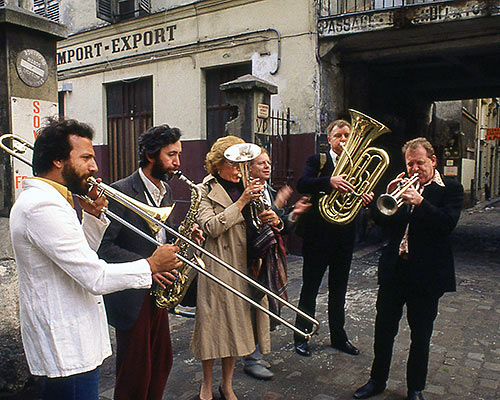
The Mike Westbrook Brass Band playing in Paris in 1984. Photograph: Goddard Arcive Portraits/Alamy
It was followed by A Young Person’s Guide to the Jazz Orchestra (also titled After Smith’s Hotel), presented at Snape Maltings in 1983, Big Band Rossini, originally commissioned by North German Radio in Hamburg (1986), London Bridge Is Broken Down, a meditation on Europe’s troubled history since the first world war (1987), The Orchestra of Smith’s Academy (1992), and Chanson Irresponsable (2001), commissioned by BBC Radio 3.
A Bigger Show took shape in 2015 with the 22-piece Uncommon Orchestra. Its personnel featured reunions with several early collaborators, including the saxophonist Lou Gare and the trumpeter Dave Holdsworth, alongside some of the musicians the Westbrooks had encountered after they made their home in Dawlish on the Devon coast in 2004.
The much-loved Blake settings were continually revised and extended over a period of 50 years, gathered together under the titles Bright As Fire, Glad Day and The Westbrook Blake for concerts in venues ranging from churches in New York and Moscow to St James’s, Piccadilly, where, in 1757, the poet was baptised. In 2023 they were performed by a group of Norwegian musicians at the Lillehammer jazz festival.
Mike Westbrook: 'I See Thy Form' sung by Phil Minton from "Glad Day" at Toynbee Hall, London 2008
With his final lineup, the seven-piece Band of Bands, Westbrook took part in a private concert for friends in Dawlish on a sunlit May afternoon in 2024. He played only a little, sitting back to listen as Kate, Biscoe and his fellow saxophonist Pete Whyman and the virtuoso accordionist Karen Street were featured in a rendering of music old and new, as ever suffused with the spirits of his great predecessors – Ellington, Charles Mingus, Thelonious Monk – but always clearly the work of a man who brought to his chosen idiom an open-hearted vision based on the principles of social justice, a fondness for barrier-testing adventure and a commitment to the essentially collaborative nature of jazz. A final performance of the Westbrook Blake took place at Blackheath Halls a few days before Christmas 2025.
Mike Westbrook’s Band of Bands, featuring the virtuoso accordionist Karen Street, perform Illusions in 2025
“Being a jazz musician is for life,” he once said. “There’s no retirement, no pension. And there’s always the lure of the next gig, the next project, which is going to be your best yet.”
He was appointed OBE in 1988.
He was appointed OBE in 1988.
Mike (Michael John David) Westbrook, composer, bandleader and pianist, born 21 March 1936; died 11 April 2026
Richard Williams also spoke at Mike's funeral and he has published his tribute on his Blue Moment Blog
Mike Westbrook – a tribute by Chris Biscoe
I joined the Westbrook Brass Band in 1979 for a performance of Mama Chicago in Salzburg. A couple of West Country gigs followed, a festival in Portugal, then we flew to Germany to begin what was for me a new touring experience. Four years with Redbrass had prepared me for the minibus travelling and nightly set-up and reloading of our PA, but not for being part of a band supported and warmly welcomed by an international audience. The Brass Band was one of three groups criss-crossing Germany. The others were The Carla Bley Band and The Willem Breuker Kollektief. A measure of the status of the Brass Band was that the agent in Germany was the legendary Vera Brandes, of Keith Jarrett Köln Concert fame.
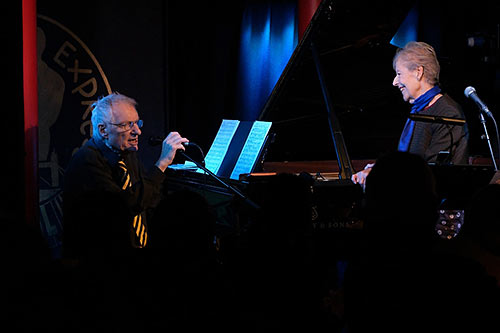
Mike and Kate Westbrook. PizzaExpress 2023. Photo credit Robert Crowley
Regular tours continued in France, Scandinavia, Italy, and the UK. Years later, during a Trio tour of Sweden, I remember playing in a modern art gallery, and realising that I was experiencing hallucinations resulting solely from fatigue. The punishing schedules continued for many years, and Mike thrived creatively in this environment. This was one of the ways in which he reflected the ethos of his greatest influence, Duke Ellington. The touring was very much part of the musical experience, integrated into compositions which covered everything from his beloved 8 bar blues to large scale examinations of the condition of the modern world in London Bridge is Broken Down.
With the support, encouragement and creative input of Kate Westbrook, time after time, he found ways to surprise and stimulate audiences both old and new with each project.
Jump forward more than 40 years and Mike was still as creative, as determined to make his next project his best ever, always ready to work with a diverse range of musicians and musics. His 9th decade saw new music written for bands large and small, jazz and not so jazz. There were also solo piano concerts, improvised ruminations on a lifetime of listening and playing, and Band of Bands, a typically oblique, lyrical and swinging reworking of some favourite pieces. Days before he died, Mike was still working on a composition based around a recording of church bells. Only three notes, but so much more to come.
Mike wrote so many great tunes. I wanted to record some of them as small group instrumentals, expressing my feelings about them in a new context. Mike was hugely enthusiastic, and with his help and encouragement ‘Music Is’ was completed in 2022. The title track comes from ‘On Duke’s Birthday’ a composition which reflected his love of the Duke as composer, arranger, bandleader and pianist.
In 2006 Mike sent me an email, subject ‘Stanley Unwin reviews Art Wolf’, a review translated by Babelfish from the Italian daily Il Manifesto. I can think of no better testament to his music:
‘Contemporary music but with those groove that only who knows of jazz can possess. “the artist lupo ghigna/nelle make us of the dead women”, sang Kate more ahead. And Mike accompanied it with “basso continuo” of euphonium, mutter, po’ a type music for band, strange thing indeed. And perfect’.
For Kate, for Mike, with love, Chris Biscoe, April 2026
Chris Biscoe plays Mike Westbrook, 'Music Is', Riverhouse Barn Arts Centre, 19th January 2025
Andy Robson (Jazzwise) pays tribute to the beloved British jazz composer, pianist and bandleader who has died aged 90
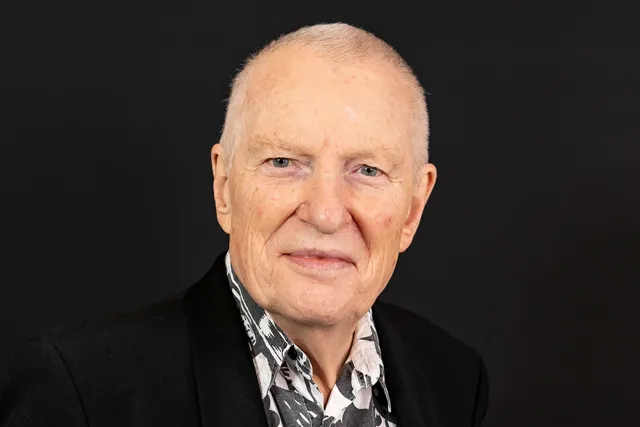
Mike Westbrook - Photo by Tim Dickeson
Stop the clocks. Mike Westbrook is dead. Just three weeks earlier he’d celebrated his 90th birthday. When you’re 90 and plagued with the bodily tribulations that father time gifts you, you might be forgiven for putting your feet up and letting your pals and family do the running around for a change.
Not Mike Westbrook. He spent the afternoon of his 90th rehearsing his band, or at least the rhythm section, in preparation for a new recording. It was a scene affectionately familiar to musicians. Lettered manuscript paper littered the floor (‘where’s A, can’t find A..’) part desultory (‘didn’t we just run over that?’) part sparky as Marcus Vergette and Coach York, bass and drums, lock down a groove or guitarist Matthew North nails a riff.
But all the time with glances and a turn of a shoulder they check in with Westbrook, his head cocked to one side, apparently elsewhere but then razor sharp with a supportive nod there, a ruminative “Mmmm…” here, those eyes as sharp as ever. He doesn’t say much to guide and signpost. It’s in that telepathic trust, the space between the composer and the instrumentalist, which music somehow shapes.
A few weeks earlier I’d bumped into Chris Biscoe, alto and soprano man, who’s played with Mike for over 40 years, from the miniaturist detail of the Trio with Mike and Kate, through the epic orchestrations of The Cortege (recently reissued) to the current quintessential Westbrook band, the Band of Bands. We were at a launch gig for Rob Cope’s new band; Rob of course is Claire Cope’s partner, herself part of a generation of women composers such as Trish Clowes, Emma Rawicz and Josephine Davies who have so flourished in the wake of Kate Westbrook’s trailblazing.
I asked Chris how come so many musicians remained loyal to Westbrook. “It’s all about family with Mike; there’s no judgement. You want to play for him. Not that he gives you that much,” he grins, “he rings you up and you’re never quite sure what’s going to happen!”, and he smiles, as so many do in the company of the Westbrooks.
Back at the rehearsal you can understand why Mike appears so at home. The venue is the Ashburton Arts Centre. Deep in his beloved Devon, its ethos of shaping strong local communities in these uncertain times through creating opportunities for all to enjoy music and theatre is close to the core values that Mike has always lived by, values shared with his wife and collaborator of 50 plus years, Kate. Whether tramping up a hill in Italy to rendezvous with Tibetan musicians or marching through a French hamlet with the Brass Band or indeed collaborating with Adrian Mitchell to create The Westbrook Blake, Mike was all about taking the music to the people, not about the grand concert hall (though he could fill those too).
Mike of course was a West Country man. OK, he was born in High Wycombe on 21 March 1936, but grew up in Torquay and Plymouth, getting schooled in Tavistock, so close to Dartmoor which would be a source of inspiration for both the Westbrooks. After initial diversions (accountancy’s loss would be jazz and theatre’s gain), and most surreally his time in National Service where he was a radio operator: “I’d spend all day in a fox hole with this radio that didn’t bloody work! Bored rigid.” His unit was even kitted out for Suez (read Strait of Hormuz for today’s equivalent in the scrabble for oil) “though of course it was chaos and none of us knew where we were going”. Plus ça change. Perhaps all that military madness fed into 1969’s wondrous Marching Song, Westbrook’s first grand scale composition. And one, like all his work, which is rich with compassion, humanity and, oh yes, mighty fine tunes bolstered by extraordinary contributions from the then young lions of the burgeoning Brit jazz scene. Some of whom, like Henry Lowther, still grace our stages with lyrical power if slightly less hair than six decades ago.
And amid the throng of Marching Song was of course John Surman. Surman and Westbrook struck up their unique partnership years before in workshops pulled together by the self-taught pianist in Plymouth Arts Centre. (Yes, it all starts and ends in the Arts Centre, all power to this threatened breed!). It was a mutual creative relationship that set each along their extraordinary musical futures. It also pre-figured many of the working relationships that Westbrook built over the years, from Mike Osborne to others still in the Westbrook ‘family’ like Phil Minton whose vox, often entwined with Kate’s, is such a feature of Westbrook’s art.
Mike liked a birthday, but it’s usually The Duke’s that he celebrated – On Duke’s Birthday being another of his master works. Duke was his perennial love and it’s no surprise that Ellington’s loyalty to his instrumentalists was echoed by Westbrook. But this time round the rehearsal breaks up as Kate strolls in armed with cake and bubbly, both of which Mike relishes, lifting his glass as the band sing you know what.
Shortly after the rehearsal Mike’s back in hospital. But we’ve been here before. On a previous hospital residency the nurses fell in love with him (of course). They plumped pillows so he could write or collaborate with the ever-devoted pianist Matthew Bourne who visited daily to transcribe. And of course, Mike won the day, getting leave of absence from hospital to direct the Band of Bands at a riotous performance in Dawlish where he and Kate had found sanctuary for many years, their white plashed terraced house a world in one small home.
But this time Mike didn’t come back. He was gone, all gone, like a train. Maybe he was on the ‘A’ train. It’s no surprise he covered Strayhorn’s heart-piercing ‘Blood Count’, recorded of course at Ashburton. That was part of a series of solo piano recordings Westbrook made in his later years which deserve fresh attention, the last one, The Piano in the Room and the Blues, released just this March.
But then there is so much in Westbrook’s life and musical catalogue we’ve not paid attention to. That he was fêted more in Europe than at home, with commissions from Sweden, Switzerland, France, Italy and Germany, accompanied by thrilling European tours, that latterly featured his splendidly anarchic last big band, The Uncommon Orchestra; his theatrical collaborations with Welfare State, his fabled residency at Ronnie’s Old Place, the Solid Gold Cadillac electric era, the recording relationship with Jon Hiseman, his affinity with nature, birdsong and landscape, and most vitally the collaborations with Kate, from the jazz cabaret of Mama Chicago to the visceral Granite Band. All this lives on.
There’s a gorgeous moment at the end of Granite where Kate sings ‘Let’s Face the Music’ into Dartmoor’s echoing Haytor Quarry. Mike always faced the music. And we’ll do our best to keep dancing. Thank you, Mike.
- Home (Main Page)
-
Mike Westbrook Pages
- Mike Westbrook Tribute
- Latest Recordings
- Selected Compositions and Recordings
- Diary
- Biography
- Recordings
- Complete Works Page 1
- CompleteWorks Page 2
- Sound Samples
- Mike's 85th Birthday
- Mike's Selected Films
- Westbrook Newsletter (SAI) Archive
- Photo Album
- Links
- Contacts
- Lou Gare Tribute
- WestbrookBand Alumni - Featured Albums
- Shop
- News
- Notice Board
- Films

Mike Westbrook
